Visitor Information
- Location: Cesky Krumlov, South Bohemian Region, 170 km from Prague
- Getting there: Bus from Prague Florenc (3 hrs) or train to Ceske Budejovice then bus
- Opening hours: Castle open Tue–Sun; park open daily year-round
- Entry: Guided tours for interiors; castle grounds free to walk
- Best time to visit: May–June, September–October; avoid July–August weekends
- Official site: zamek-ceskykrumlov.eu
The Scale of the Place
Cesky Krumlov Castle is the second largest castle complex in the Czech Republic, after Prague Castle. That statistic is easy to read and difficult to appreciate until you are standing inside the fifth courtyard looking back at the way you came in. The complex contains 40 buildings arranged across a rocky promontory that the Vltava river wraps around on three sides. It took several noble families and several centuries to build what you see today.
The earliest fortifications date to around 1253, when the Witigonen family established a stronghold on the rock above the river. Over the following centuries, the castle passed through the hands of the Rosenbergs, the Eggenbergs, and finally the Schwarzenbergs, each family leaving architectural traces. The result is a layered complex where Romanesque foundations sit beneath Gothic towers, which sit beneath Renaissance arcades, which sit beneath Baroque additions. Reading the castle means reading 700 years of Central European history in stone.
The Castle Tower
The round tower at the entrance to the castle complex is one of the most photographed structures in the Czech Republic. Its distinctive painted facade — trompe-l'oeil stonework applied in the 16th century — makes it immediately recognisable. Climbing the tower is included in the general admission and provides the best elevated view of the town below and the river bend that defines the site's geography.
The tower is worth the climb even if you skip the interior tours. The view from the top explains immediately why this location was chosen: the river creates a natural moat on three sides, leaving only a narrow neck of land connecting the promontory to the surrounding hills. A small garrison could hold this position against a much larger force.
The Castle Gardens
Above the main castle complex, a formal Baroque garden extends across the plateau. The garden was laid out in the 17th century and restored in the 20th; it is now one of the best-preserved Baroque gardens in Central Europe. The scale is impressive — the central axis runs for several hundred metres, flanked by trimmed hedges and punctuated by fountains and statuary.
At the far end of the garden stands the Baroque theatre, one of the most completely preserved examples of its kind in the world. The original stage machinery, painted backdrops, and costumes survive largely intact. Access to the theatre interior is by guided tour only, and the tour is genuinely interesting for anyone curious about how theatrical performance worked in the 17th and 18th centuries.
The garden is free to enter and open daily throughout the year. In summer, it hosts outdoor performances and events. In autumn, the colours of the surrounding forest make it particularly worth visiting.
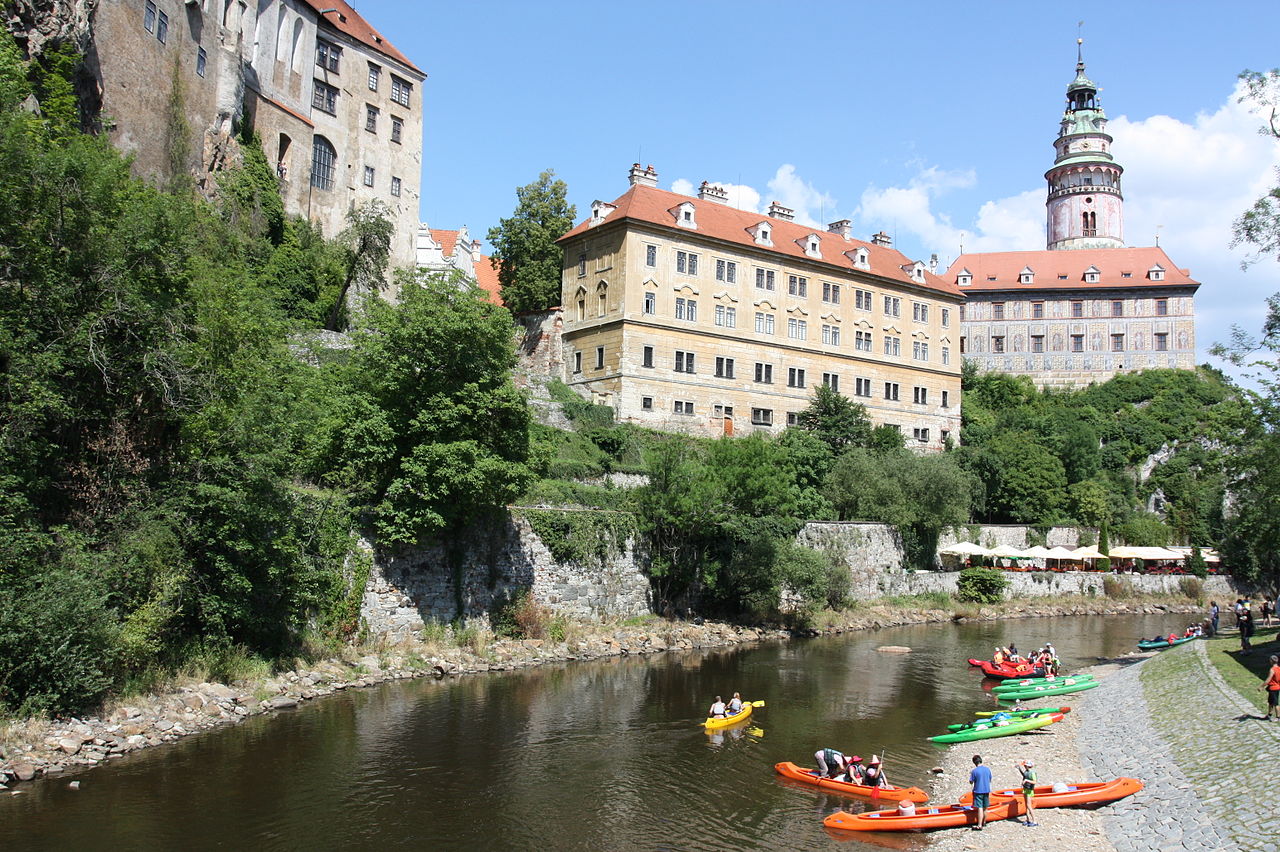 Photo: Wikimedia Commons / CC BY-SA 4.0
The Town Below
The historic town centre of Cesky Krumlov is a UNESCO World Heritage Site in its own right, designated together with the castle in 1992. The medieval street plan survives almost intact, and the buildings lining the main square and the lanes running down to the river date largely from the 15th to 18th centuries.
The town is small enough to walk completely in an hour or two, which makes it manageable even on busy days. The main square (Namesti Svornosti) has the usual tourist infrastructure — restaurants, cafes, souvenir shops — but the side streets retain more of the original character. Walking down to the river and looking back up at the castle is one of the better views in Bohemia.
The bears kept in the castle moat are a curiosity worth mentioning. Bear-keeping at Cesky Krumlov has been documented since the 16th century, and the tradition continues today. The moat enclosure is visible from the first courtyard; the bears are usually active in the morning.
Crowds and Timing
Cesky Krumlov has become one of the most visited destinations in the Czech Republic, and the crowds in July and August can make the experience genuinely unpleasant. The narrow streets of the old town fill with tour groups, the restaurants have queues, and the castle courtyards become congested.
The solution is straightforward: go in May, June, September or October, and arrive early. The town is significantly quieter before 10am even in summer. Staying overnight — rather than arriving on a day trip from Prague — also helps, as the day-trippers leave by early evening and the town recovers some of its atmosphere.
For those interested in the broader history of the Schwarzenberg family and their role in Bohemian history, the Schwarzenberg family archives maintain online resources with historical documentation.

